



SafeStorage Dubai Logo

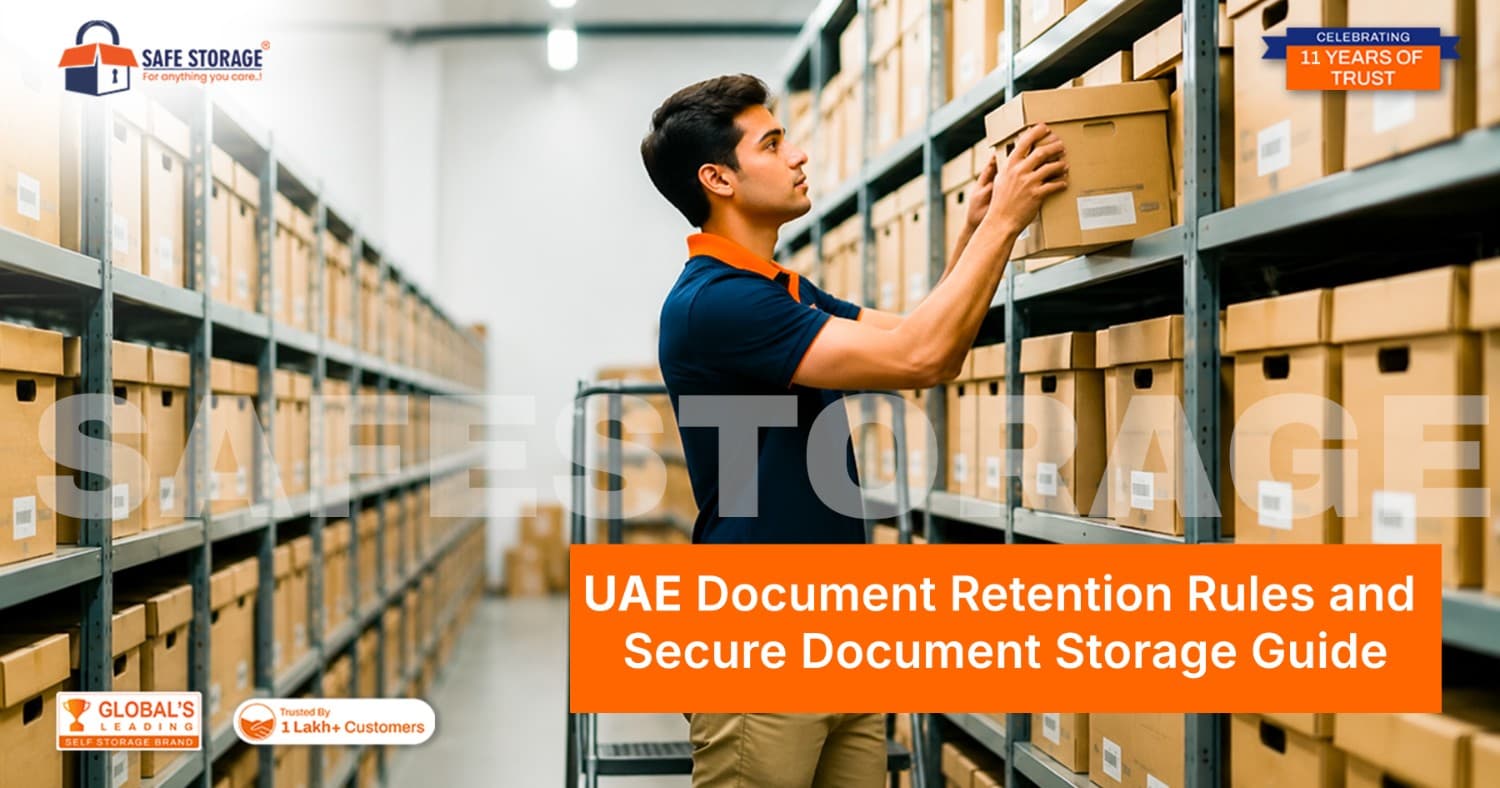
UAE Document Retention Rules and Secure Document Storage Guide

Storage Tips
September 4, 2026
SafeStorage Dubai Editorial Team
10 min read
UAE Document Retention Rules and Secure Document Storage Guide
Click to copy the full article text to clipboard

About the Author

By Farah Al Mansoori | SafeStorage Dubai | Updated 2026 

Farah Al Mansoori writes on UAE business compliance and records management for SafeStorage Dubai, covering practical guidance for companies navigating VAT, commercial, and employment record-keeping obligations. 
 

Information

Each UAE-registered company must have a certain number of business documents stored for a period of time which cannot exceed certain limits. These records must be kept in a condition which will be acceptable for use in case of audits, investigations, and/or lawsuits.Knowledge of document storage requirements in UAE is not merely a formality - it is an obligation stemming from VAT legislation, commercial companies legislation, and anti-money laundering rules. This article describes the types of documents which UAE businesses are obliged to store and ways to create a secure and proper document storage process in UAE. [Get Free Quotation]
 

Why Document Retention Matters in the UAE

  • Since the introduction of VAT into the UAE legal system, the country's regulatory environment has become quite mature. Consequently, the requirements for record keeping have become more strict. 
 
  • Now businesses are not expected to just provide their returns in accordance with regulations. They must also be ready to show the documentation which proves that each operation has been done properly, and not just the one in question, but even that which has been made several years before. 
 
  • It usually happens gradually — files scattered across offices, digital copies with no backup, paper archives with no index, and no clear point person responsible for retention. Once a business scales past a handful of employees, an informal approach to records stops being workable, and a defined document storage UAE policy becomes necessary.


What UAE Law Requires You to Retain 

The obligation under UAE VAT regulations to retain certain documents is not specified in one piece of legislation. Retention periods vary depending on document types, as the obligation is found in VAT legislation, commercial companies legislation, labour law, and anti-money laundering legislation. 
 

VAT and Tax Records 

Under UAE VAT regulations, taxpayers must retain their accounting records, invoices, credit notes, and other supporting documents for at least five years from the end of the relevant tax period. 
 
Some records need to be retained for a longer period, e.g. records regarding real estate. The Federal Tax Authority publishes detailed guidance on which categories of tax record must be preserved and in what format.
 

Retention of Commercial and Company Documents

 
UAE federal commercial companies regulations stipulate that commercial companies retain their accounting records, minutes of board and shareholders' meetings, and statutory registers for a period that is provided in the legislation, which is usually calculated in years.
 
Incorporation of the company documents, renewals of licenses, and shareholders' resolutions should be considered permanent documents that do not qualify for disposal after the expiration of retention periods, since they might be needed for license renewals, transfers of ownership, or resolving disputes. 
 

Employment and HR Records 

Contracts of employment, payroll records, calculation of termination of service, and work-related injury claims are subject to different retention requirements according to the UAE labour law and, in case of free zones, the specific regulations of the respective free zone authority. 
 
The files relating to an employee might have to be available even years after he or she has left the business organization because of any dispute regarding his or her end of service visa or any other matter. 
 

Records in Relation to Anti-Money-Laundering and Compliance

Companies that come within the purview of UAE anti-money laundering regulation, such as most non-financial businesses and professions, are expected to retain their records concerning customer due diligence, transactions, and any suspicious activity for a certain period of time after the cessation of the business relationship or transaction. 
 

Retention Periods at a Glance

  1. VAT accounting records, tax invoices and credit notes: generally retained for a minimum of five years from the end of the tax period
 
  1. Real estate related VAT records: retained for an extended period beyond the standard VAT requirement
 
  1. Company statutory registers, board minutes and incorporation documents: retained for the life of the company and beyond, where legally required
 
  1. Employment contracts and payroll files: retained well past an employee's departure date
 
  1. AML customer due diligence files: retained for a defined period after the relationship or transaction ends
 
  1. These timeframes are a general guide only. Businesses should confirm current requirements against the UAE Ministry of Finance and applicable federal law before finalising an internal retention schedule, as periods can be revised by legislative amendment. 


The Risk of Getting It Wrong

Non-compliance with UAE document retention rules carries consequences beyond a failed audit. If a company cannot produce supporting documentation during a VAT audit, the Federal Tax Authority can disallow input VAT claims, issue penalties, and reassess prior filings.
 
In a commercial dispute, missing minutes or missing contracts can weaken a company's legal position in UAE courts. And where AML obligations apply, an inability to produce due diligence files can trigger regulatory action against the business itself, not just an individual.
 
Beyond the direct penalties, poor recordkeeping damages a company's standing with banks and investors during due diligence, and it slows down routine tasks such as licence renewal, ownership transfer, and employee offboarding.
 

Confidentiality and Access Control 

The type of documents required to be stored is the most confidential of all those that the company stores: tax returns, payroll information, contracts, and AML documents. Confidentiality should be considered one of the most important aspects of a document storage Dubai solution. [Get Free Quotation]
 
This implies that the access to such documents should be limited only to those employees of the company authorized to do so and there will be a chain of custody for the physical documents, while digital versions of such documents should be stored with controlled access instead of being saved in accessible folders in the company's computer network.
 
A well-written policy concerning access to the documents will prevent the loss or alteration of records. 
 

Structuring a Document Storage UAE Strategy 

A workable retention strategy starts with a document inventory: what categories of record the business generates, which law governs each category, and how long each category must be kept. From there, businesses typically choose between three approaches.
  • In-House: filing cabinets and/or a dedicated Records Room facility that is fine for the smallest businesses but hard to handle and secure in larger volumes
 
  • Electronic storage only: scanning the documents and keeping them electronically, which requires an auditable process for back-ups and access control to make it legally valid
 
  • Offsite records storage: outsourcing organized, indexed box delivery to a third party storage specialist, thus freeing office space while providing an auditable chain of custody 
For companies with high volumes of paper records, an off-site document storage UAE provider such as SafeStorage offers a structured alternative to keeping years of archives on-site. Records can be logged, boxed, and indexed so that a specific file can be located and retrieved on request, without the office having to dedicate space to years of accumulated paperwork.
 

How SafeStorage Supports Business Records in Dubai

SafeStorage has been storing business and personal belongings across the UAE since 2015. SafeStorage’s Document Storage product allows companies maintaining their statutory, tax, HR, and contract records to store them in organized and indexed boxes for request-based retrieval, along with a Business Storage product suitable for businesses requiring to archive their equipment, stock, and office furniture in-between office moves. 
 
Documents stored are indexed and organized based on the category or dates for easy access of documents such as invoices or contracts during an audit or in cases involving litigation.
 
Once the retention period elapses and it is deemed necessary not to retain a particular document anymore, it will be securely shredded in order to ensure that it will not just be disposed of but properly destroyed to end the cycle. 
 

Constructing an Internal Retention Policy

It would be better to have a written policy on how to handle retention of files since having an internal policy would provide guidelines other than individual judgment for the employees. The policy usually involves:
 
  • Annual review of the policy according to the UAE laws or any change in the law. 
 
  • A list of document categories the business generates, mapped to the law that governs each
 
  • The retention period that applies to each category, with the start date clearly defined
 
  • Who is responsible for filing, retrieving, and eventually authorising disposal of each category
 
  • How confidentiality is maintained while a document is in storage and in transit
 
  • The shredding or destruction process once a retention period has genuinely expired, and how that destruction is logged 
An annual review of this policy, or any update to laws and regulations, ensures the company stays in line with current UAE standards and does not operate on outdated regulations. 
 

What Our Client Says 

"Our archives were housed in a separate room in the Dubai office where we stored tax records and HR files for years, and retrieving documents for our VAT audit became a major problem. Once we moved our archive to SafeStorage, we finally had an actual index, and their staff even assisted us in determining which documents to keep and which to throw away after the retention period." It made our next audit far less stressful." — Operations Manager, Dubai-based trading company
 

Frequently Asked Questions


1. How long should VAT records be maintained in UAE?

 Generally, VAT accounting records, invoices and credit notes need to be kept for at least five years after the expiry of the relevant tax period with some real estate documents being kept longer according to the Federal Tax Authority.
 

2. What happens if a business is not able to provide the document asked for during the audit process?

Disallowing input VAT deduction claims, reassessment of previous tax returns and imposing penalties on the business becomes the right of the Federal Tax Authority. In addition, lack of documents puts the business in a weak position in case of any dispute. 
 

3. Do digital copies satisfy UAE retention requirements?

Digital copies may be accepted by the Federal Tax Authority as long as they are complete, accessible and tamper proof but it is advisable to confirm the specific acceptable formats of each type of documents.[Here More Information]


4. What should be done after the documents have completed the required retention period? 

After the expiry of the required retention period and where there is no further obligation to keep the document, the company should properly shred the document. 
 

5. In what way does off-site storage of records ensure confidentiality?

The off-site provider has a structured procedure where the files are logged and boxed according to the category and have access control only to authorized requests. The chain of custody is recorded, making it more difficult to duplicate than the in-office informal storage of files.
 

6. Is the writing of retention policy mandatory by law?

According to the UAE law, there is no specific format that a business needs to maintain for its document retention policy. However, having such a policy will enable a business to show consistency in their practice in case retention issues are challenged legally. 
 

7. Where can a business confirm current UAE retention periods?

 Current requirements should be confirmed against the Federal Tax Authority, the UAE Ministry of Finance, and applicable federal commercial companies legislation, as periods can change with legislative amendment.
 

Conclusion

There are specific UAE document retention requirements and they are quite detailed; they vary from one document category to another, and there are serious implications of failure to comply with them.
 
Document Storage UAE should be structured where there is a structured inventory of documents, set retention period, access controls, and end-of-life document destruction. [Here More Information]


S

SafeStorage Dubai Editorial Team

Storage Expert

Share this article

Why Dubai Residents Trust SafeStorage

SafeStorage Dubai is the city's most trusted self-storage provider, offering secure, clean, dust-protected units for households and businesses alike. Every unit is monitored by 24/7 CCTV, secured with individual PIN access, and kept clean and dust-free β€” giving every customer peace of mind whether they are storing for a week or a year.

What We Store

We accept a wide range of items: sofas, beds, dining sets, wardrobes, white goods, boxes, seasonal clothing, sports equipment, business inventory, office furniture, trade show displays, documents and files, vehicles (cars, motorcycles, classic cars), artwork, antiques, and e-commerce stock. Our unit sizes range from small lockers to full-villa-sized rooms β€” so you only pay for exactly the space you need.

Door-to-door Pickup Across Dubai

One of our most popular features is our door-to-door pickup service. You do not need to rent a lorry, hire movers separately, or make multiple trips. Our team comes to your door, carefully loads your belongings, transports them to our secure facility, and delivers them back when you need them. We serve every neighbourhood in Dubai including Business Bay, Dubai Marina, Jumeirah, JBR, DIFC, Downtown, Deira, Bur Dubai, Al Barsha, Dubai Investment Park, Motor City, and beyond.

Flexible Plans, Pay Only for the Space You Use

There are no long-term lock-ins, and you only pay for the space you use. You can start with as little as one week of storage, extend month by month, or book long-term for the best rates. Getting started takes less than two minutes: visit our website, select your unit size, book your pickup slot, and we handle everything else. Most customers have their items picked up within 24 hours of booking.

Get a Free QuoteHow It Works

10 Essential Storage Tips for Dubai Residents

1. Wrap and Cover Everything Against Dust

Dust is the most common threat to items in any storage setting, and Dubai is a particularly dusty environment. Before storing, wrap furniture in breathable covers, seal boxes with strong tape on all seams, and use furniture blankets over wooden and upholstered surfaces. This keeps fine dust out and your belongings clean for retrieval. SafeStorage Dubai units are kept clean and dust-protected, and our team supplies quality covers and wrapping materials as part of our door-to-door service, so everything you store stays in the condition you left it.

2. Disassemble Furniture Before Storing

Disassembling bed frames, dining tables, wardrobes, and shelving units before moving them into storage can reduce the space they occupy by 40–60%. A king-size bed frame, for example, takes up roughly half the floor area when broken down versus when assembled. This directly reduces the unit size you need β€” and therefore your monthly bill. Keep all screws, bolts, and fixings in labelled zip-lock bags taped to the corresponding furniture piece so reassembly is straightforward later. SafeStorage's team can assist with disassembly and reassembly as part of our door-to-door service.

3. Use Uniform Box Sizes for Maximum Efficiency

Mixing box sizes creates gaps and unstable stacking. Standardising your boxes β€” typically medium (60x40x40 cm) for books and heavy items, and large (60x50x50 cm) for light bulky items like bedding β€” allows you to create clean, stable columns from floor to ceiling. Each additional layer of boxes you can safely stack is space you are fully utilising. SafeStorage Dubai sells quality double-walled boxes in standard sizes specifically designed to stack together. Using uniform boxes can increase the effective capacity of your unit by 25–35% compared to random assorted sizes.

4. Label Every Box on Three Sides

The most common frustration in storage is being unable to find a specific item without unpacking half the unit. Labelling each box clearly on the top and two sides with the contents, the room it belongs to, and a priority number (1 = need frequently, 3 = rarely needed) allows you to locate items quickly. For items you may need without warning β€” such as documents, tools, or seasonal clothing β€” place those boxes at the front of the unit. A simple spreadsheet or photo log of what is in each box, numbered sequentially, takes 15 minutes to create and saves hours of searching later.

5. Create a Central Access Aisle

When loading a storage unit, it is tempting to fill every square centimetre from front to back. This works if you never need to retrieve a single item β€” but most people do. Leave a 60–70 cm aisle down the centre of the unit so you can walk to the back without having to move everything. Place items you may need on a schedule (seasonal clothes, specific documents, equipment used quarterly) within arm's reach on the left and right sides of this aisle. Items you are storing indefinitely can go all the way to the back. This simple organisation system makes every retrieval visit quick and stress-free.

6. Protect Soft Furnishings Properly

Sofas, mattresses, and cushions should be stored in breathable fabric covers β€” not plastic sheeting. Plastic traps moisture and promotes mould growth, which can penetrate deep into foam and fabric. Breathable woven covers allow air circulation while keeping out dust and insects. Mattresses should be stored upright (vertically) rather than flat to avoid compression deformation over time. Sofas can be wrapped in moving blankets for additional protection. SafeStorage Dubai supplies high-quality furniture covers and mattress bags as part of our packing service.

7. Store Heavy Items at the Bottom, Light at the Top

This fundamental packing rule protects both your belongings and yourself. Boxes of books, kitchen appliances, and tools should go at floor level. Fragile items like glassware, lamps, and electronics should be cushioned on top of sturdy lower layers, never at the bottom where they could be crushed. When stacking within a box, place heavier items at the base and lighter items on top. If you are using shelving inside your unit, place the heaviest items on the lowest shelf. This keeps the unit stable and prevents the kind of cascading collapses that can damage an entire unit's worth of belongings.

8. Empty and Clean Appliances Before Storing

Fridges, freezers, washing machines, and dishwashers must be thoroughly cleaned and completely dried before going into storage. Any residual moisture inside a sealed appliance will generate mould and odours within days. Defrost the freezer fully, wipe every surface dry, and leave the door slightly ajar during storage to allow air circulation. Washing machines should have the drum and rubber seal wiped clean and dried. Ovens and microwaves need grease and food residue removed. Taking 30 minutes to prepare appliances properly ensures they are ready to use immediately when you retrieve them β€” with no unpleasant surprises.

9. Review Your Unit Contents Every Six Months

Long-term storage has a way of accumulating items that are no longer needed. Every six months, take 20 minutes to review your inventory list and ask honestly: do I still need this? Many people find that after a year in storage, a significant portion of their items could be sold, donated, or disposed of β€” freeing them to downsize to a smaller unit and reduce their monthly costs. SafeStorage Dubai makes this easy: simply schedule a partial retrieval, go through your items, remove what you no longer need, and return the rest. Many of our customers have reduced their unit size after a review and lowered their monthly bill.

Frequently Asked Questions β€” Storage in Dubai

Do storage companies in Dubai offer door-to-door pickup?

Most traditional storage facilities in Dubai do not include pickup β€” customers are expected to bring their own items to the facility. SafeStorage Dubai is different: our door-to-door model means our team comes to your home or office, loads your belongings, transports them to our facility, and delivers them back when you need them. We cover all Dubai neighbourhoods including Business Bay, Dubai Marina, JBR, Jumeirah, Downtown, Al Barsha, Deira, Bur Dubai, JVC, JLT, and Dubai Investment Park.

What is the minimum storage period at SafeStorage Dubai?

SafeStorage Dubai offers flexible arrangements with no rigid minimum term. Most customers store on a month-to-month basis, and you can start with as little as one week of storage for renovation or short-term moving situations. There are no cancellation penalties β€” simply give seven days' notice when you want your items returned. For longer-term storage of three months or more, we offer discounted rates. Annual plans provide the best value per month and are popular with expats and businesses storing long-term.

What items can I NOT store in a Dubai storage unit?

SafeStorage Dubai does not store the following items: food or grocery items, liquids, detergents, cosmetics, ornaments or jewellery, medicines, and masala or spice items. The following are also prohibited in any professional storage facility in Dubai: flammable liquids (petrol, paint thinner, acetone), compressed gas cylinders, explosives or firearms, live animals or plants, perishable food or anything that will decompose, illegal substances or counterfeit goods, and corrosive chemicals. Everything else β€” furniture, electronics, clothing, documents, sports equipment, vehicles, business inventory, and seasonal items β€” is welcome at SafeStorage Dubai. If you are unsure about a specific item, call our team at +971505773388 and we will advise.

Can I access my stored items anytime?

SafeStorage Dubai offers facility access during operating hours: Monday–Sunday 8 AM–8 PM, seven days a week. Business customers and those with special requirements can arrange extended access hours. Alternatively, rather than visiting the facility yourself, you can request specific items or boxes to be delivered to your address β€” our team will retrieve and deliver them within 24–48 hours. This delivery-on-demand feature is particularly popular with customers who store business inventory or archive documents they need occasionally.

How do I choose the right storage unit size in Dubai?

The right unit size depends on what you are storing. As a general guide: a small unit (25 sq ft) suits documents, seasonal items, and 10–15 boxes. A medium unit (50–75 sq ft) comfortably holds a studio or one-bedroom apartment. A large unit (100–150 sq ft) accommodates a two-to-three bedroom apartment. An extra-large unit (200+ sq ft) handles a full four-to-five bedroom villa. The easiest way to get the right size is to call or WhatsApp SafeStorage Dubai β€” our consultants will ask about what you need to store and recommend the exact size. Getting the size right first time avoids paying for unused space or being forced to upgrade.

Does SafeStorage Dubai offer packing services?

Yes. SafeStorage Dubai offers both a DIY packing option and a full professional packing service. For the DIY option, we provide high-quality packing materials including double-walled cardboard boxes in standard sizes, bubble wrap, packing paper, stretch film, furniture covers, mattress bags, and wardrobe boxes β€” all available for purchase. For the full service, our trained team arrives at your property, wraps and packs every item professionally, creates an inventory list, and loads everything into our vehicle. The professional packing service is popular with customers who are busy, have fragile or high-value items, or simply prefer to leave the heavy lifting to someone else.

Can businesses use SafeStorage Dubai for commercial storage?

Absolutely. SafeStorage Dubai serves a large number of business customers including e-commerce sellers, trading companies, law firms, marketing agencies, event management companies, medical device distributors, and retail businesses. Business storage plans are available for inventory, documents, office furniture, trade show equipment, seasonal stock, and archival records. Our facility meets UAE document storage compliance requirements for the mandatory 5-year document retention period. Businesses benefit from flexible unit sizes that can be upgraded as inventory grows, without the commitment of a long warehouse lease. Call +971505773388 to discuss your business storage requirements.

How quickly can I get storage in Dubai?

Getting started with SafeStorage Dubai is fast. For same-day pickup, book by 12 PM and our team will collect your items on the same day. For next-day or scheduled pickups, we typically have slots available within 24–48 hours. The booking process takes under two minutes online, or you can call +971505773388 and one of our consultants will handle everything for you over the phone. There is no paperwork to complete in advance β€” we bring the necessary documents with us on pickup day.

What neighbourhoods in Dubai does SafeStorage serve?

SafeStorage Dubai provides door-to-door service across all Dubai neighbourhoods. Our coverage includes Business Bay, Downtown Dubai, Dubai Marina, JBR, Jumeirah 1, 2, and 3, Palm Jumeirah, JLT, JVC, Al Barsha, Motor City, Sports City, Dubai Hills, Arabian Ranches, Mirdif, Deira, Bur Dubai, Al Quoz, Dubai Investment Park, Dubai Silicon Oasis, Nad Al Sheba, Al Warqa, International City, and Al Nahda. If you are in a neighbourhood not listed here, contact us β€” we cover virtually all of Dubai and the surrounding emirate areas including Sharjah and parts of Abu Dhabi for long-term storage customers.

How do I get my items back from storage?

Retrieving your items from SafeStorage Dubai is simple. Call, WhatsApp, or email your dedicated storage consultant with a list of what you need returned. You can request your entire unit contents, specific boxes or items, or a combination. We schedule delivery within 24–48 hours to any Dubai address. If you need partial retrieval β€” for example, retrieving a specific piece of furniture while leaving the rest in storage β€” simply describe what you need and our team will retrieve exactly those items. There is no penalty or fee for early retrieval, and you can retrieve items as many times as you like during your storage period.

Does SafeStorage Dubai store vehicles?

Yes. SafeStorage Dubai offers dedicated indoor covered vehicle storage bays for cars, SUVs, motorcycles, scooters, and classic vehicles. Vehicle storage is indoor and under 24/7 CCTV surveillance. You only pay for the space your vehicle occupies. This is ideal for expats travelling abroad for extended periods, classic car owners who want their vehicle stored safely over summer, or individuals who own a second vehicle they do not use daily. All vehicle storage bays include a complimentary wash before return. Call +971505773388 for vehicle storage availability and pricing.

Get a Free QuoteCall +971505773388
Get Free Quote